I’ve written about Karl Lagerfeld often on this blog. In the past I found much to admire about him: his drive, his levels of energy, his capability to go in different directions, his ability to change mentally and physically. He was also quite the wit, as can be seen here and here, and I admired that too.
Despite all that, Lagerfeld still has allies. Like Anna Wintour, a friend who thought highly of him. It’s not a fluke he was the focus of the recent Met Gala, run by Wintour. And anyone who cares for fashion and design that flipped through this retrospective the Tines did of his work at Chanel, Fendi, H&M would agree just how influential and powerful his work was.
So what to do with difficult people? I often think the best way to think and talk about them is like this. Instead of saying “I admire Mr/Ms X”, I try to say, “There are things I admire about Mr/Ms X” or “I admire anyone who can do Y”. That is the case when it comes to me and Karl Lagerfeld now. There are things I admire about Lagerfeld. And I admire anyone who can do some of the things he achieved.
Like any famous person, Karl Lagerfeld is not my friend, my foe, or even a member of my family. I don’t have to accept or reject him unconditionally. You don’t have to either.
Besides being a famous fashion designer, he is also well known for the Karl Lagerfeld diet. You can read more about that here and here and here and here.
In the early 90s, people soured on AI and work on it stopped. That period was known as AI Winter.
Smarter Cities is an idea likely in its own winter period. I concluded that when I watched the segment above on the subject. The segment’s focus (according to its Youtube comment) was this:
In 2017, the City of Toronto embarked on a project with a subsidiary of Google called Sidewalk Labs. The idea was to develop a parcel of Toronto’s industrial waterfront in order to create a “smart city”. At first, the idea was met with a lot of enthusiasm, but eventually a number of concerned citizens, journalists and planners started to raise questions about data privacy, competition and public policy issues that Sidewalk Labs could not answer. What happened to Sidewalk Toronto and why are we so drawn to the idea of futuristic urban utopias? To help answer that: John Lorinc, author of “Dream States: Smart Cities, Technology and the Pursuit of Urban Utopias;” Josh O’Kane, author of “Sideways: The City Google Couldn’t Buy;” and Vass Bednar, Executive Director, Master of Public Policy in Digital Society Program at McMaster University.
It’s a good segment with good people critical of the idea of smart cities. Watching it, I could see why you might think that any city would be unwise to aspire to be a smarter one.
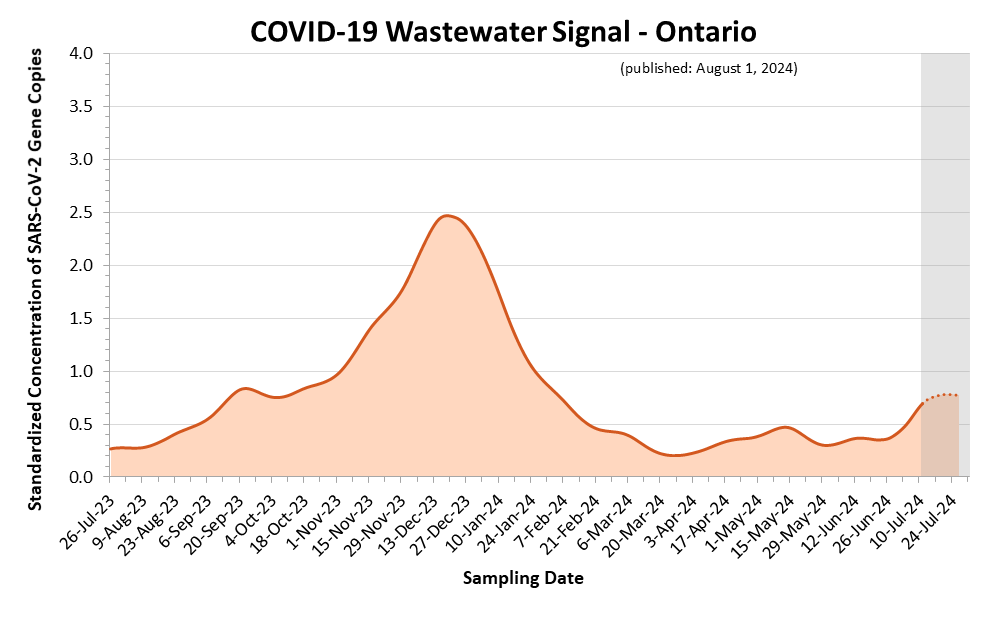
If you did think that, I’d ask you to think again. I believe cities, provinces, states and countries all benefit from becoming smarter. For example in Ontario, smart meters were deployed across the province to more accurately measure power consumption and help people shift their usage. Wastewater was measured during the pandemic to see if things are getting better or worse. And it’s not just public initiatives that matter: private services like Waze give drivers a view of the whole city and let them choose the best routes as they make their way to their destination.
Whenever there is municipal or state data available and software to process it, then you have a smarter city. It’s not at the scale that an organization like Google wanted it to be, but a smarter city nonetheless.
I strongly feel we need more of this. Smarter cities can be greener cities. Smarter cities can be better functioning cities. That’s why I am glad that Toronto is continuing to explore this, with things like its Digital Infrastructure Strategic Framework. And it’s not just Toronto: here is a list of the top 10 smart cities in the world and what makes them smarter.
The folks at Vox have a good guide on how to find your purpose in life. According to them, your purpose…
is a long-term calling, act, or way of life that interests you
something you have some competence in
makes a marginal difference in the world
For some people, their purpose is obvious. Their work is their purpose. Or their role as a parent or sibling gives them purpose. Some gain purpose from acts of kindness. Others get it from creative tasks.
Perhaps you don’t drink (red) bordeaux (never mind white bordeaux). Maybe you are one of the people who nowadays prefer burgundy. Or new world reds. Or reds from elsewhere in Europe. I used to be like you. I liked big bold jammy reds. Reds with intense fruit and flavour. High alcohol reds. Cab savs. Syrahs.
Over the last few years, though, I moved away from that and towards bordeaux wines. I like the high concentration of merlot in their reds. I enjoy “the chewier, drier style of red bordeaux (that) can go well with something more savoury such as roast beef” (as Jancis Robinson says here). I especially like that some of them come in under 13% ABV. More so, I love the value. You can obviously spend a fortune on great bordeaux, but you can find some very good ones around $20 per bottle.
I got thinking of writing about them when I read this piece by Malcolm Jolley. He talks about the region and its wine generally, then he focuses on this: Chateau Argadens. Not only is it a fine wine made by great winemakers, it’s also a bargain. Indeed, right now it is on sale for $16.95! Get a few bottles at that price. Mind you, it seems to come around every year in the Vintages section of the LCBO, so don’t panic about missing it. (Then again, if they are selling it off, who knows?)
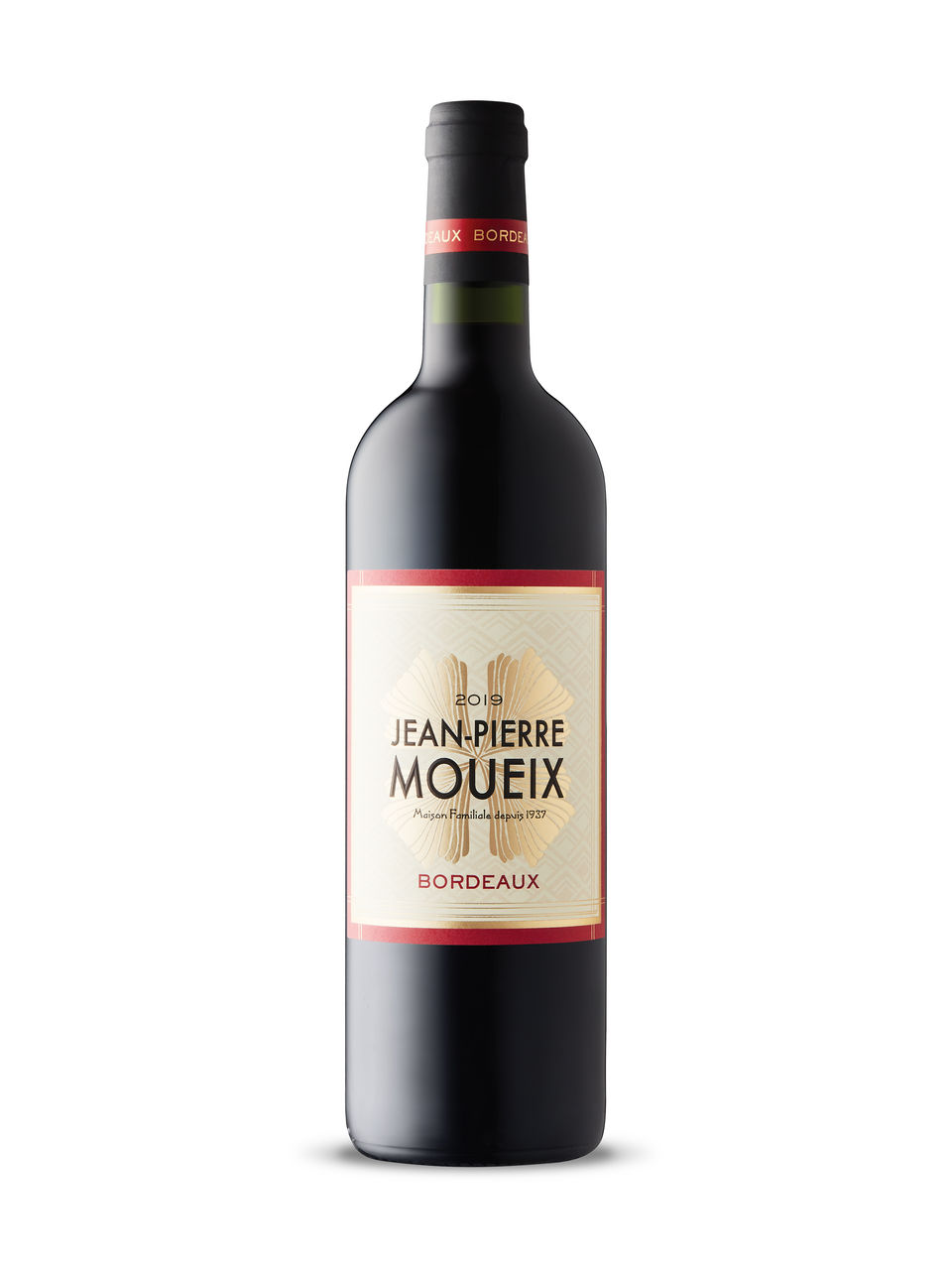
Another one I liked in the past is this one: Jean Pierre Moueix bordeaux. It too is made by serious wine makers and it comes well rated. It has a lower alcohol content, and goes well with food like steak. (Want more? Try these: Clos Bel-Air 2016 or Chateau Hauchat 2018.)
There’s also some white bordeaux that’s good in the LCBO, like Cap Royal Bordeaux Sauvignon Blanc 2021. I enjoyed that one. Again: good winemaker. Fans of fume blanc should check it out. (There’s also a lot of not so great white bordeaux in the general LCBO section, so buyer beware.) If you can get your hands on white bordeaux from the restaurant St. JOHN, do so. I had it there with a delicious meal of fish and pork and it paired up perfectly.
If you like bubbles, then there are several well regarded cremants from the region, including this one, which is a steal at under $15: Celene Bordeaux Améthyste Brut Crémant. Cremants will go with mostly anything, from oysters to dessert. Also fine all by themselves.
There’s so much good wine in the LCBO and elsewhere. But fans of good value wine should consider grabbing a bottle or two of bordeaux.
After 24 years, one of my favorite bands has released a new album. It’s incredible that not only has this happened after a quarter of a century, but that it has managed to do so well. It’s incredible and fantastic.
Leading up to the release, they’ve received some great reviews and lots of good press. You can read some of that here in the New York Times, or in the Guardian (here and here), or Pitchfork.
With the release of this new album, I can think of them as being of three times. One time is Now, of course, in the 2020s. A second time is the 1990s. In that time they were at their peak. Here you can see them performing in 1999, just before what I thought was then end (as no doubt many people did):
The third time – the 1980s – is the time I remember them most fondly. That was the time they were just starting. Here’s some rare footage of them from then:
Pick up Fuse when you can. Meanwhile, if you are a Spotify user, here’s their Complete Discography, I believe. Give Fuse and more a listen, there.
It seems only yesterday that Kenneth Branagh was wowing us with his version of Henry V. Now instead of playing one of the younger Shakespearean lead roles, he is playing one of the oldest, as he gets ready to direct and star in a new production of King Lear on London’s west end. I am sure it will be a huge success. Shakespeare has been good to him, and vice versa.
Reading that, I started to think about some of the pieces I’ve collected on aging. For example, if you or someone you love is wondering how to manage living in your home as you get older, then read this.
As we age, we hope we can retire. And by retire, we hope to work less if at all. Sadly, in some Asian societies “Retirement” just means more work. That may not be a fate limited to Asian countries, I fear.
What do you need when you get older? An old person project! Let John Demont explain. Or if the thought of getting older and wrinkled bothers you, read about preventative botox . To each their own.
P.S. I could not close out without including one of my favorite movie scenes, with a very bright and brash Branagh rallying the troops with his truncated version of the Saint Crispin’s Day speech:
I love that speech, that scene, and his portrayal of it.
“When faced with an episode that used the French language itself as a narrative tool, the Canadian team were again able to fall back on the differences between French and French Canadian.” (Bart in Paris shows this brilliantly.)
“In the Quebec dub, the Simpsons family speaks with a thick working-class dialect of Montreal French called joual. They also do something the France dub doesn’t do: they regionalize the scripts, subbing in Quebecois politicians or places for the more US-centric references.” You can see this in the famous bit with Principal Skinner and Steamed Hams bit:
I continue to find interesting things in the area of astronomy, math, physics and more. Here are some of the best of them. I hope you like them! (Yes, there will be stoned earthworms, and something about Uranus. :))
Can non-mathematicians learn and appreciate math? This piece looks at some books on math education that try to do that. The jury is out, though I think it’s possible.
One of the problems with generative AI like ChatGPT is it makes you think it is magical. You type in some prompt, it comes back with a complex answer, the next thing you know, you are thinking this thing is smarter than a human. It doesn’t help that there is so much hype surrounding the technology. All of this can make you think it’s supernatural.
Well, it isn’t. It’s simply good IT. It consists of data, hardware and software, just like any other IT. To get a better appreciation of the ordinary nature of that, it helps to look at two recent examples: the AI the New York Times recently built and the AI Bloomberg just built.
It’s best to start with what the Times built. They used software called nanoGPT (karpathy/nanoGPT: The simplest, fastest repository for training/finetuning medium-sized GPTs) and took the works of Jane Austen, Shakespeare and more to build a chatGPT-like program on their laptops. Then they walked through the steps of getting it working, here: Let Us Show You How GPT Works — Using Jane Austen – The New York Times. It works pretty well after much much training. Obviously it is not as massive or sophisticated as ChatGPT, but after reading the article, you will have a better sense of how this technology works, and why it’s impressive but not magical.
Bloomberg today released a research paper detailing the development of BloombergGPT, a new large-scale generative artificial intelligence (AI) model. This large language model (LLM) has been specifically trained on a wide range of financial data to support a diverse set of natural language processing (NLP) tasks within the financial industry.
You can find a link to that research paper, here: BloombergGPT: A Large Language Model for Finance. What I liked about that paper is it walks through the approach they took, the data they used, and the technology deployed to make their model. Even better, they talk about how it is currently succeeding and what some of the limits of it are.
I’m happy that both these companies have been good about sharing what they are doing with this technology. I might even try and use an old laptop to build my own AI. I mean who wouldn’t benefit from tapping into the genius of Shakespeare or Jane Austen.
Is April the cruelest month? It can be in Canada. This month we’ve had summer like temperatures followed by light snow and freezing weather. It’s kinda what we expect here.
Here’s 90+ things I thought interesting that I really believe you might as well. Something for you to read on a rainy/windy/sunny/who knows April Sunday.
Pandemic: Yes, I am still going on about the pandemic. Hey, whatever public health activity is going on where you live, COVID is still making the rounds. People are still getting sick and dying. There’s a new variant going around: it’s called arcturus and so far it’s just in India. But who knows what could happen with it.
If you still want good data on covid cases, the New York Times has it. Here is a grim reminder of just how badly New York was hit by COVID. No wonder they still track it carefully.
In my last newsletter, I talked about feeling a weird nostalgia for the early parts of the pandemic. I felt that again watching this old clip of the Roots and the cast of Hamilton on Jimmy Fallon performing “Helpless”. I wonder what people will think years from now when they see it?
Elsewhere in the US, guns continue to be a major problem. Here’s the story of one of the worst guns in particular: the A-15. That’s a good piece on a horrible device.
Healthcare: there were a number of pieces on healthcare in Canada at the beginning of 2023. It could be because the provinces were in negotiation with the Federal government for more money. In the end, at least some provinces signed a health deal. I expect all will come around and sign.
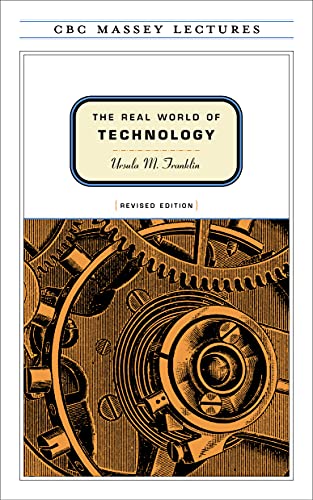
Ideas: A good source of ideas is Ursula Franklin’s lectures on the Real world of technology. Austin Kleon was reading it and he reminded me of how good it was.
Famous People: Some major axe grinding in this piece on Brad Pitt, Angelina Jolie, and Jennifer Aniston. I think they will all be fine, in their own weird way, whatever skeletons are in their closet.
And on that fun note, I’ll close off this newsletter and the month of April. As always, thanks for reading this and rambling along with me. I hope you found it worthwhile. Happy Spring. Now the good weather comes.
I found this image on Instagram some time ago and I kept a digital clipping of it to remind me to make stuff even if the only person that cares about it is me. I would advise you to do the same. Sometimes I imagine an audience that does like whatever I make, but I am fine to make it just for me. Kids are like that, and they’re happier as a result. We should be more like kids, like the kid we once were. Make things and be happy with the making of it. Even if you immediately toss it aside. For making stuff can do wonders for us.
Happy Friday. Make something this weekend: a poem, a salad, a chalk drawing, a record of some sort. You’ll be better because of it.
‘Shortlife’ is a small device showing how much percent of your life is completed based on your personal life expectancy.
You give him your birthday and your gender and he programs the clock based on this information and “the average number in your country provided by the World Health Organization (WHO)”.
If you want a more accurate estimate of your life expectancy, you can go here. That online calculator’s estimate “is based on a detailed statistical analysis of NIH-AARP data and conducted by Wharton professor Dean Foster” and takes into account not just your age and gender, but also other factors like how fit you are and how much you drink and smoke.
Based on that calculator, it estimates I have twenty more years to live, if I am lucky. It also states that there is a 25% chance I won’t have more than a dozen. Of course it is just an estimate, a probability. I could die today, or I could live for another 40 years. But the likelihood of 12 (and no more) I think is good. When we were in school, 12 years felt like an eternity. I suspect these will not.
One problem with such a clock is it meant for people who see the glass increasingly empty. We need a clock that shows things increasing full. There is such a thing, of course. But it’s not a clock. It’s a tree. If you plant a tree and you are lucky, the tree will grow along with you. Growth: that’s what trees represent. A tree you plant can represent you as a growing living thing, not as a dying thing.
I think the clock is smart, of course, but I think a tree is wise. Get both, and be wiser, still.
P.S. I wrote about the joy of planting and owning a tree, here. That tree is no longer on my property, and perhaps that makes it better.
If you like playing Wordle, then you should make a guide and an opponent of Wordlebot. I check it every time I finish Wordle.
Using Wordlebot as a guide, I noted which words it used first and second. Based on my notes it seems to always use SLATE as the first word. Of the second word I noticed it uses, CRONY is a common choice. That makes sense: those two words give you AEO and Y as well as CNRST. I find I can get a lot of matches this way. And if I don’t, I know the third word has an O or a U, and the remaining letters are easier to choose from.
Often I will play SLATE and then play CRONY even if I have matches with SLATE. My goal these days is to get it in three. I will only go for it in 2 if there is a good chance I can. (Like one day this month when the word was PLATE.) Currently the majority of my scores are 4: my goal is get the majority to 3. I am not sure that is possible, but it is what I’m aiming for.
While Wordlebot is a good guide, I also use it as an opponent. My hope here is to win by getting the word in less tries than Wordlebot. It does not happen too often. My next best hope is to tie Wordlebot but get a lower luck score. If we tie in tries but it has a high luck score, I also consider that a win.
One reason it is hard to beat Wordlebot is due to the eliminate process it uses. While the first word it uses tends to be SLATE, if it gets matches, it may play a word that comes from out of the blue but it is not. Wordlebot seems to calculate what possible words could solve the puzzle and then play a word to help eliminate them. If I had the ability to do the same, I would! Most of the time I do something less mentally taxing.
Wordle is a fun game, still. I especially love that people still post their scores on twitter. I consider it watercooler material. (“How’dya do on Wordle last night, Bob?” “Got it in 3” “Whoa, nice. Ok, have a good day” :)) Like Wordle, I don’t take Twitter too seriously either. The two go good together, like chocolate and peanut butter.
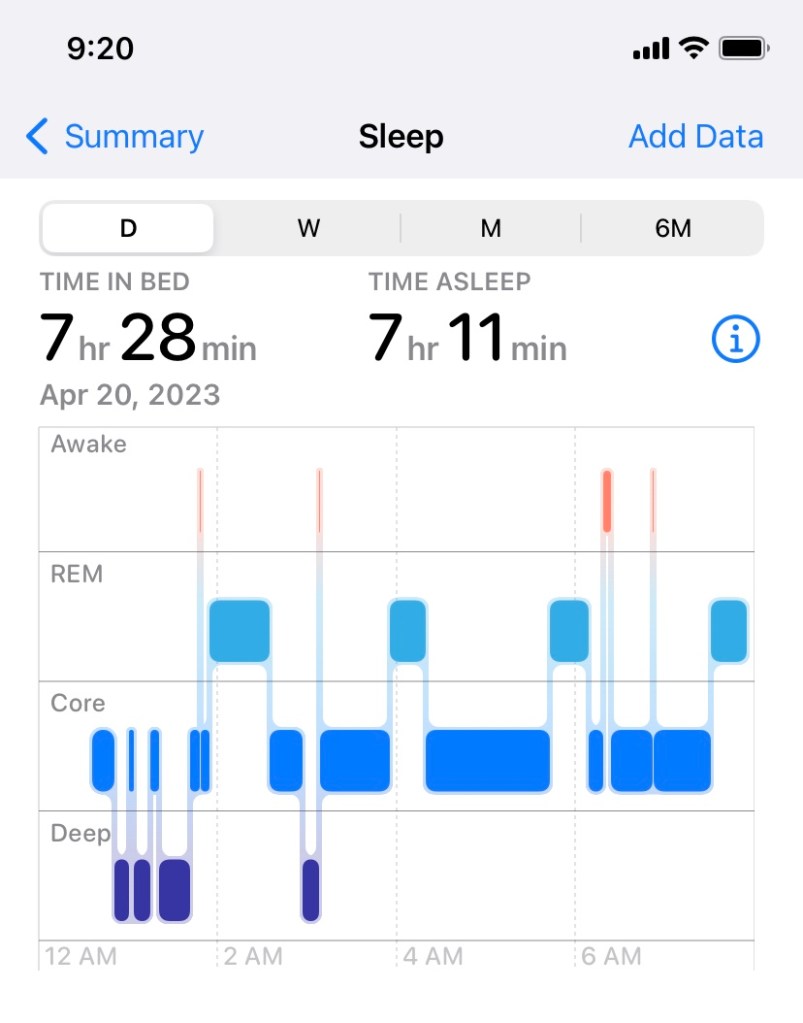
I wear my Apple Watch every night while I sleep, and I have found it’s been helping me sleep better.
My watch sends a ton of information to my phone during the day, including information about how I am sleeping. When I wake in the morning, I head over to the Sleep summary in the Health app on my iPhone and check how I did that night. Here’s an example:
You can see this was a pretty good night for me. I slept for 7 hours, and I managed to get in a fairly decent amount (for me) of deep sleep. I don’t know if this is typical for most people, but it is for me. I have a number of deep sleep periods, about 4 periods of REM sleep, and the rest is core sleep. You can see I woke up twice, but barely for any time at all. I also found I was refreshed and alert the next morning.
That wasn’t typical though. If you look below, you see my sleep for the week:
There’s quite a number of days where I was awake for large periods of time. Every day I would wake up and see that and think: what can I do to fix that? Some days it would be something simple, like the room was too warm. Or I ate too late. Other days it is due to more difficult things like too much stress. (Stressful days tend to cause other issues, like eating badly, which compounds the problem.)
Before I had this data, I would let myself sleep badly for a long stretch of time. Now when I start seeing I am not getting enough sleep, I work hard to get the right conditions to get a better sleep the next night.
There are plenty of things you can do to maintain good health: eat well, exercise, and sleep well. The Apple Watch can help with all of those things. If you can get one with these features, I highly recommend it.
P.S. Why is deep sleep important? It could be the time your brain gets cleaned. To see what I mean, go here.
Hey, are you still optimistic? If you are filled with optimism (or if you are not), it is all about the stories you tell yourself over and and over again. Read that, but more importantly, learn to tell yourself better stories.
Someone on my street was kind enough to plant snowdrops in their front yard. Last week they were bursting from the ground and giving me the hope I always feel when I see them. Seeing snowdrops, I know winter is over: seeing snowdrops I know spring is starting. I love the significance of this small white flower. They’re a beautiful reminder.
If you are ever wondering about planting flowers in your front yard, I encourage you to do so. I am sure I am not the only one who walks by such beauties and feels joy. You will be giving a gift to the world with whatever you plant. How great is that?
Here’s some more useful links on staying fit, physically and mentally. Plus some things on sleep, because sleep is an important part of fitness. And more!
Another person who’s work I’m a fan of is Kehinde Wiley. You likely know him for his famous portrait of Barack Obama. The Guardian has a good profile of him there.
There’s no living artist who I am a bigger fan of than Richter. He’s getting very old, though (85), and he is thinking about giving up painting in the future. But for now, here’s a story of how Gerhard Richter Rides Again, in The New York Times.
Yesterday I wrote about using Instagram as a recording device to track special events, such as life during the pandemic. As I was writing about it, I started thinking about Instagram as a service.
A weird thing happened to that service in the summer of 2022. The folks at Meta (who own it) hamfistedly tried to change the app, only to face a backlash from famous and not so famous. Unlike Twitter, Meta actually backed off from some of the changes (though they are still trying to make Reels happen). I’m glad they did.
In some ways Instagram has become my default way of sharing my life, mainly through Stories. The same 50 or so people see all my posts and can keep up with what I find interesting, and that amount is fine with me. On Twitter you can imagine lots of people are paying attention to what you post: on Instagram, you know who is. I no longer use Facebook, and who knows who reads these blog posts. 🙂 So Instagram it is.
Like many people, Instagram photos are not my life, but rather a version of it. I realized that especially when I put together my collection of images from Year 1 of the pandemic. There were plenty of things that I took photos of but never posted there. Anyone not close to me might think that’s everything happening in my life, but it’s only a sliver of the pie.
It’s good that Instagram allows you to collect Stories in Highlighted sections. It helps with the ephemeral nature of them. In most cases, the fact that photos in Stories are fleeting is good. But not always. It’s good to shape some of them into a virtual scrapbook to display.
Of course I could use Instagram Posts, but like many people, I post to Post less and less. Now I mostly use it to mark a moment in time.
Instagram may not be the best place to publish photos, but it’s pretty good. Of course everything could change tomorrow, and all of it could be gone. I keep that in mind and keep my photos backed up separately. You should too.
Instagram has plenty of problems. Anyone reading their Wikipedia page can see that. But it has its benefits and does better than most social media these days. At least for me. Find me there, at least for now, at bernie_michalik.
Instagram stories are an odd thing, at least mine are. I post almost random images of things in my life, not thinking they add up to anything. But if you are living through a dramatic period of time like the first year of the pandemic, and if you collect those images together, as I did here in “Covid: Year 1”, they take on a narrative that was not there when you snapped them and saved them.
The narrative began even before the pandemic was declared. I have photos of me going to Chinatown and eating in many places, because word had gone out that a new illness had broken out in Wuhan, China and people were avoiding that part of the city because people were afraid of coming across someone who had it and then get sick. I was down there to do a small part in keeping some of those places in business by eating as much as I could. (Brave, I know 😊.)
Soon, general precautions started. Hand sanitizer was everywhere, like this one at my work:
Then the pandemic was officially declared in March 2020 and things started to break down. I have photos of the grocery stores being cleared out of flour and potatoes. Toilet paper was scarce. People were queueing up to get into grocers and the liquor store, which both had limited occupancy. Plastic barriers went up, and everything else was shutdown: work, restaurants, stores, gyms. It was a time of lockdown.
To occupy ourselves, we adopted hobbies. People made bread. I drew and made zines. I even wrote some half decent poems. I continued to blog, and traffic shot up.
We worked at home. Every damn day. Our hair grew long. We finally got masks to go shop for food.
We ordered take out. Lots and lots of take out. Restaurants pivoted to this to stay alive. Some, like my favorite restaurant Brothers, didn’t make it. Many did, due to hard work and help from the government. We drank pet nat and cremant to celebrate.
In summer we finally ate outside, albeit like this:
Eventually we got to eat indoors for a bit in the fall. Otherwise, if we wanted to celebrate birthdays or Easter, we did it with people in our circle. Collecting with others outside our circle was frowned upon.
We purged our homes to make space. I had a garage sale, and was surprised by the people who showed up and bought things. We were awkwardly happy to see each other, and dealt with money for the first time in ages.
We made the best of it. We watched the blossoms in High Park in Toronto via a TV channel. We watched our talented friends put on shows on Instagram and Youtube and Twitch. We walked on streets closed off to traffic. We banged pots and pans for health care workers. We did not go to the movies, even though the movies tried to open in the summer of that first year.
We downloaded apps to keep track of COVID and to know what to do. We downloaded apps to finally travel in the fall. We wore our masks everywhere. We wore sweat pants almost as much, if not more.
We dealt with bad people. The anti-maskers. The anti-science people. We celebrated when Trump lost.
If we were parents, we tried our best to help our kids. We took them out on Hallowe’en and let them get treats delivered by chutes. We made them get up for virtual classes via Zoom and other technologies. We ordered them Christmas presents online because the stores remained closed in many places like Toronto.
Most of all, we awaited the coming of vaccines and yearned for a normal time. For many, it was the worst of times, losing their livelihoods and their loved ones. Getting ill. For some, it could also be the best of times, as it often was with me.
Here’s some bits and snippets on the New York I’ve been collecting over time. I hope you like them.
A great source of such snippets of life in New York can be found here, in the New York Times section called Metropolitan diary. Just little bits of life in the Big Apple, with wonderful grease pencil drawings to go with them. (See one such drawing below).
Speaking of the Times, noted conservative David French is joining them as an Opinion Columnist. I have to say, these conservatives often start out there with great praise but then become awful. Let’s see how French does. I’m not optimistic.
Yesterday I wrote of a landmark of the city closing down: the Pennsylvania Hotel. Here’s a story on a smaller landmark also leaving: Alleva Dairy in NYC Will Close. I am sure that place contains many stories itself.
Manhattan is a region of extremes when it comes to rich and poor. On the rich side, here’s a Look Inside the NYC Apartment of MALIN GOETZ Founders. Pretty posh. Also, what’s it like surviving as a staff member of the high end store, Bergdorf Goodman? Well not as tough as being Flaco the owl, but tough nonetheless. To see what I mean, see this: Surviving 10 Hours and 32 Minutes at Bergdorf Goodman. If nothing else, you can see what providing exemplary service is all about.
(Top image: Christopher O’Keeffe, the director of loss prevention, locks the door at the end of the shopping day of Bergdorf. Credit…Landon Nordeman for The New York Times)
If you are not familiar with the idea, let me explain with this quote pinched from one of the links below: “Victory gardens are gardens grown by civilians during times of widespread food insecurity. The gardens were encouraged by the Canadian government during the world wars, as a way to feed both civilians and troops.”
In time of high inflation brought on to some degree by the pandemic, such a garden might help in several ways. But heck, if you want to stick with growing flowers to lift your spirits, that’s ok by me too.
I had been thinking about the Pennsylvania hotel recently. I first started thinking about it when I read this: Discovering another vintage two-letter phone exchange on a West Side sign. See the bottom? Things like MU 2-2655 were how phone numbers looked in the Big Apple (and other places too). Forget about area codes like 212.
One of the most famous of these old two letter phone exchanges was PEnnsylvania_6-5000 (PE 6-5000) for two reasons. One, it was the number assigned to one place and one place only: the Pennsylvania hotel. Two, Glenn Miller wrote a famous song about it, called…PEnnsylvania_6-5000. (My Dad loved this song, and whenever I hear the title, I can hear him shouting out with the band: PEnnsylvania 6-5000!).
Sadly, having a storied presence as well as being famous is not enough to survive. The Times has a piece on how its going to be demolished soon. That’s a shame. I hope the don’t regret it like they do the demolition of Penn Station.
As you can see from the photo being held, it was a massive hotel, and one deserving of its own exchange.
I highly recommend you read that piece on it in the Times. It had quite the run.
Now let’s join in with the the Muppets as they do their version of the famous song:
It looks like it is going to be cloudy but warm here in Toronto this weekend. That’s fine. I am happy for the warm weather and the lack of snow. It’s tulip time and I love tulips, so one thing I might be doing is either getting some more or just window shopping for them.
Of course weekends are also good for sleep. If you are trying to catch up on yours this weekend, here’s some guidance on how to fix broken sleep schedule.
Do you know someone moving into their first apartment? If so, they might appreciate this checklist . They might appreciate more than that, but it’s a start. 🙂 If they need a new sound system for their place, maybe they’d like this new Sonos speaker.
Thursday is a great day to be productive: you just got over hump day (i.e., Wednesday) and if you can get a lot done today, you can feel more relaxed as you head into Friday and then the weekend.
If you have your own playlists, I recommend you put them on. If you do not, that head over to domino.com and read this: A Good WFH Playlist Is the Difference Between a Slow Day and a Productive One. They have a number of lists from various people: one of them is bound to help put you in a mood to GTD (get things done) as you WFH (work from home).
Given the contentious nature of AI and ChatGPT, you might think think that those pieces would have asked tough questions of Altman concerning AI. Especially since Leslie Stahl did something similar to execs of Microsoft, a few weeks earlier. Perhaps the work of Stahl is why Microsoft / OpenAI wanted Altman to get out there with his story. If that was the intent, then it seemed to work. Nothing too tough in either of these profiles.
Then again, perhaps they were written as beat-sweeteners. After all, getting access is just as important for tech journalists as it is for political journalists. If you want to write more about AI in the future, being able to ring up Altman and his gang and get through to them for a comment seems like something you might want for your job. No doubt profiles like that can help with that access.
If that’s you, consider this. If there is a Walmart near you that sells groceries, go to the Walmart. And if there is not a Walmart near you but there is one on Instacart, then sign up for Instacart and buy your groceries that way.
I have been shopping at Walmart via Instacart for well over a year now and during this time I have been very satisfied with the goods I’ve received from them. The produce is excellent, the meat is excellent, the commodity goods are fine, and both high end and low cost items (“Great Value” vs “No Name”) are good. Most importantly for me, the savings are substantial. It never ceases to amaze me how the exact same product can be $0.50-$5.00 less at Walmart than Loblaw or Metro. Other than price, there is no difference in terms of what you get. You are essentially paying a Loblaw tax (or Metro tax) for buying from them.
I understand why people like shopping at Loblaw: the stores are pleasant, they have great selection, and their President’s Choice brand is still a treat. But you are paying a high premium for that.
Should you switch to Metro or Farm Boy or some other place? Not if you want to save money. What about No Name from Loblaw? Well, I checked it out, and many of the No Name products are still more expensive than every day Walmart products.
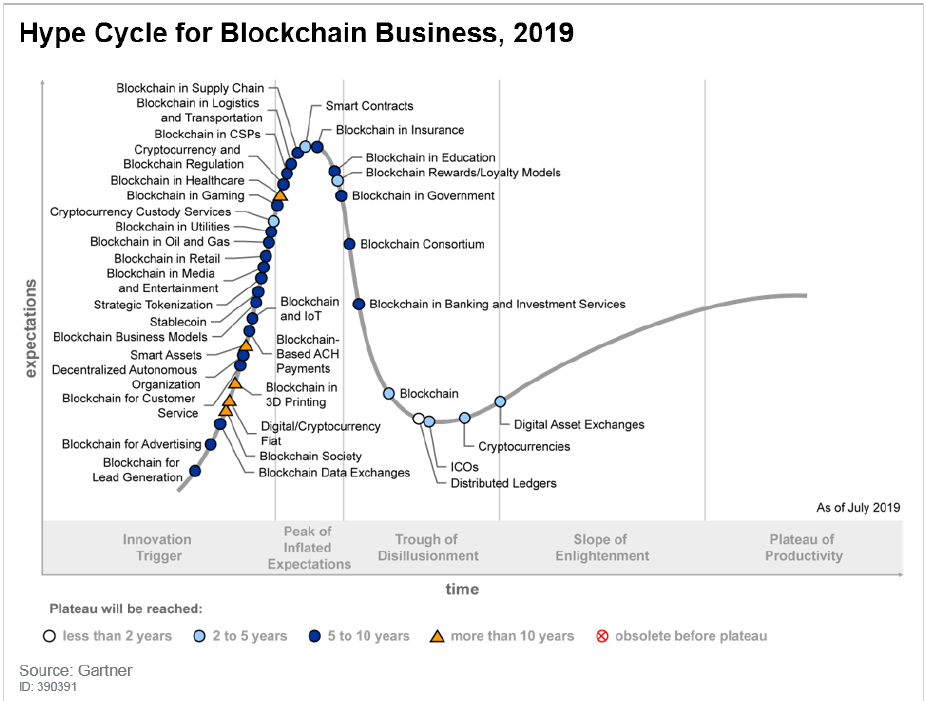
For those not familiar with it, the chart below breaks it down further and helps you see it in action. Let’s examine that.
Chances are if you are not working with emerging IT and you start hearing about a hyped technology (e.g., categories like blockchain, AI), it is in the phase: Peak of Inflated Expectations. At that stage the technology starts going from discussions in places like Silicon Valley to write ups in the New York Times. It’s also in that phase two other things happen: “Activity beyond early adopters” and “Negative press begins”.
That’s where AI — specifically generative AI — is: lots of write ups have occurred, people are playing around with it, and now the negative press occurs.
After that phase technologies like AI start to slide down into my favorite phase of the curve: the Trough of Disillusionment. It’s the place where technology goes to die. It’s the place where technology tries to cross the chasm and fails.
See that gap on Technology Adoption Lifecycle curve? If technology can get past that gap (“The Chasm”) and get adopted by more and more people, then it will move on through the Gartner hype curve, up the Slope of Enlightenment and onto the Plateau of Productivity. As that happens, there is less talking and more doing when it comes to the tech.
That said, my belief is that most technology dies in the Trough. Most technology does not and cannot cross the chasm. Case in point, blockchain. Look at the hype curve for blockchain in 2019:
At the time people were imagining blockchain everywhere: in gaming, in government, in supply chain…you name it. Now some of that has moved on to the end of the hype cycle, but most of it is going to die in the Trough.
The Gartner Hype Curve is a useful way to assess technology that is being talked about, as is the Technology Adoption Curve. Another good way of thinking about hype can be found in this piece I wrote here. In that piece I show there are five levels of hype: Marketing Claims, Exaggerated Returns, Utopian Futures, Magical Thinking, and Othering. For companies like Microsoft talking about AI, the hype levels are at the level of Exaggerated Returns. For people writing think pieces on AI, the hype levels go from Utopian Futures to Othering.
In the end, however you assess it, its all just Hype. When a technology comes out, assess it for yourself as best as you can. Take anything being said and assign it a level of hype from 1-5. If you are trying to figure out if something will eventually be adopted, use the curves above.
I love this: Ikea and Marimekko have teamed up to create a collection of home goods at affordable prices that are also beautiful. They range in prices from this low cost bag at $2:
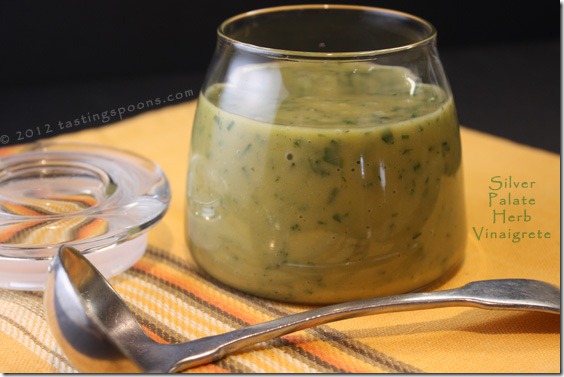
I have been remiss. I have been hoarding so many good recipes since May of 2022, and yet I have not shared any of them. Terrible. Well, let’s put an end to that here and now by bringing you a feast of slurpable soups, super salads, and scrumptious sandwiches, for starters.
I highly recommend them if you are interested in the topic. Thoughts I had after reading them:
The experiments do well to show that empathy is not a quality limited to humans. But of course it makes sense it is a quality that many species should have. After all, empathy is a very good way to help everything survive. It’s not surprising, therefore, that other mammals have it.
There is more to survival than eating. Rats in these experiments chose to be helpful over eating chocolate. Many humans I know of could learn something from these rats.
Empathy does not seem to be something distributed willy nilly. There is some selectivity when it comes to empathy in the rats, just like there is between humans. That also makes sense.
We know so little of the world, never mind ourselves.
All social media companies are bad, but some are successful. The older ones like Meta and Twitter have fallen on difficult times for many reasons. They are bad companies doing badly. And the new kid on the block, TikTok, has gotten all the wrong attention recently. It’s a bad company doing well, at least in some aspects. Let’s talk a look.
Meta/Facebook: Meta continues to do poorly, and I for one am glad about this. Remember, no matter how stupid Twitter is or how creepy tiktok is, Meta/Facebook is all that and worse. For how they are creepy, read this on the slow death of surveillance capitalism in WiReD. Or this bit of outrageousness on how GoodRx leaked user Health data to Facebook and Google (Google is also bad.) And it is not just GoodRx: Cerebral did it too. Sure health web sites like GoodRx and Cerebral are horrible, but the social media companies facilitated it.
As for stupid, just think of the metaverse. Or don’t. Disney is giving up. More will too. And that will lead to more Facebook/Meta layoffs.
Tiktok: Tiktok continues to be under fire politically. And Mark Z would love to see it get shut down and replace it with Instagram Reels.
For some companies, it gets too much attention. So they panic when they see people are using tiktok to definfluence others, for example.
Other Tiktok pieces that got my attention: this piece on Olivia Dunne, college gymnast has 6.7 million TikTok followers. I don’t, but Some people like Cory Doctorow. If you are one of them, you will like his piece on Tiktok’s enshittification. Speaking of crappy, this is on borg drinking and tiktok. Young people being dumb is not news: the innovative ways they are dumb is.
Additionally here’s two pieces on their tech. One on their API and one on their rss feed. Enjoy while you can. David Crosby did. He was great on using twitter.
Over at Criterion they have a list of ten films selected by Kazuo Ishiguro. They have a large collection of these lists, but I especially loved his for two reasons. One, I gained a better appreciation for these particular films. But more than that, I got a better way to think about film itself.
I highly recommend his piece. There is so much good stuff at that web site, including many great films, of course. But take the time and read that.
Once upon a time, web sites were simple. Now they are complicated and sometimes bloated. Just go to the web site of news organizations like CNN or the New York Times and you will know what I mean.
But there is a way to avoid that. Just go to the light/lite versions of their web sites. This is lite CNN. This is a lighter New York Times (TimesWire) And here is an aggregator site that does something similar for a number of topics, like tech: The Brutalist Report – tech.
Kudos to companies that build lightweight versions of their web sites. Not everyone has high speed Internet connectivity. And not everyone needs lots and lots of information. Keeping it simple is cool.
(The title is an extract of the original title for the computer magazine, Dr. Dobbs Journal. It’s original title was: dr. dobb’s journal of Tiny BASIC Calisthenics & Orthodontia (with the subtitle Running Light Without Overbyte))
Well, two handy guides. One from the Verge and one from the Washington Post. The Verge talks about the phenomenon in general, while the Post is more specific.
It’s possible that the AI software that generates imagery will get better. But for now, those guides are helpful in spotting fakes.
(Image from the Verge. It is highlighting things to look for: weird hands, illegibility, odd shadows.)
Like many people, I thought twitter usage was going to decline in 2023 due to all of the shenanigans of Elon Musk. While it seemed like usage was dropping off, I wanted to take some measurements to be certain.
To measure usage, I started by creating a list called good_twitter. It contained 98 accounts. I figured if the users on this list stopped tweeting, I would stop too. Then I wrote some python code to call twitter’s API and count the number of times each person on the list tweeted. I started counting at the beginning of January.
My first thought was that people would tweet less and less each day. However, as you can see from this chart below, on average the people on my list tweet around 250 times / day. Some days it’s over 350, some days it drops to around 150. (And one day my program died and I only counted 50. :)) So people are not tweeting less as time goes by.
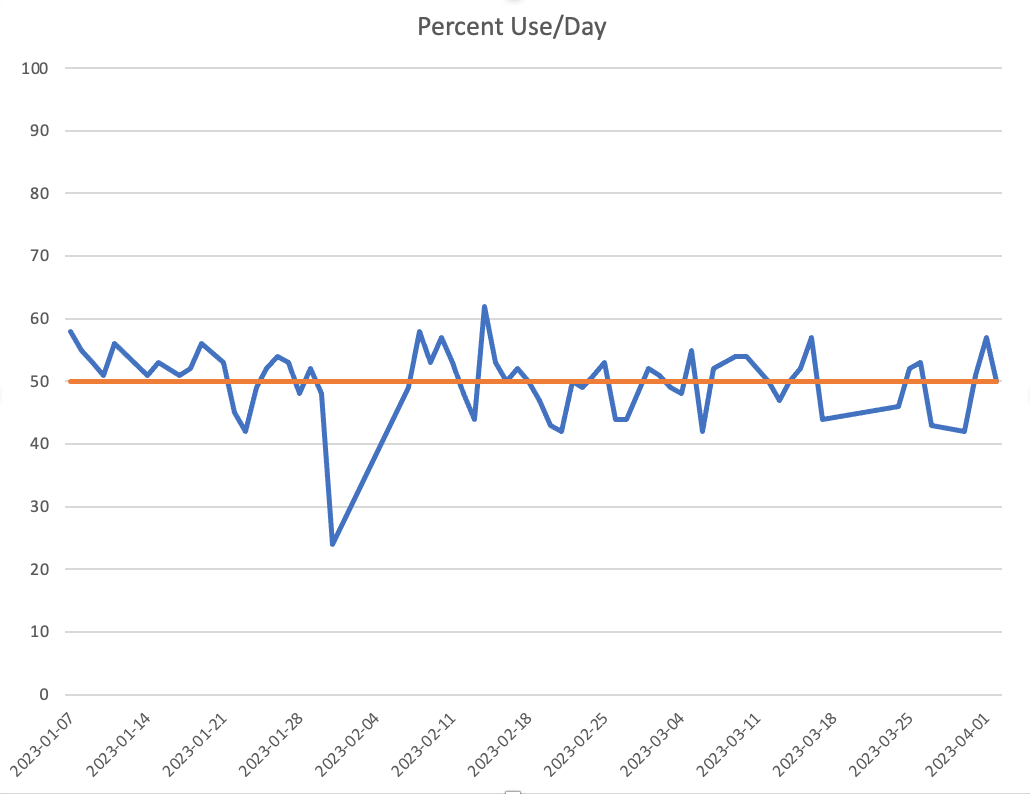
My second thought was that some people were dropping off, but other people on the list were tweeting more, and hence the total amount of tweets was not dropping. To measure this, I counted how many people on my list tweeted once or more per day. The chart below shows approximately 50% of the 98 people on the list tweet at least once a day.
Given these two results, myfinal thought is that people are not giving up on twitter, even with all the problems we all have with it. I found that surprising. I expected a big decline initially. Then I expected a gradual decline. I don’t see either.
I don’t know why only 50% of users in the good_twitter list tweet while the other 50% does not. I am sure some people have quit twitter. But the hard core — like me — seem to be sticking around.
P.S. A fascinating byproduct of this study is how individuals tweet. I would have thought everyone uses twitter the same way. Wrong! Look at this chart below:
It turns out most people on my good_twitter list (and me) tweet/retweet 0-10 times a day. We are all part of the Long Tail to the right.
However there are two other types of people on the short end of the tail to the left. There are power users who tweet/retweet between 20-50 times a day every day. And there are a number of super users who tweet/retweet 50-100 times a day. (Power and super users are my nicknames.)
Some of the power users are obvious: they are mainly news and government accounts. Less obvious ones tend to be activists. They use twitter as a soapbox, pulpit, what have you. I have a few super users I follow: Shawn Micallef, Anthony DeRosa, Deray and a couple more. For power and super users, retweets make up most of that content.
All that said, it’s been an interesting experiment, but I am not sure if I will continue to track usage. It may not be up to me: I expect Musk and company will turn off my free access to the API, and that will be that. And I am satisfied with my final thought that usage is staying constant for now.
Like any study, YMMV. But besides my good_twitter list, I also measured a few of my shorter lists and I found roughly the same result: at least half of the people on the shorter lists tweeted once a day.
Let me back that up: the Southerners of Southern Living do. They have oven cleaning tips here and here and specific tips on how to clean your oven door, here and how to clean oven racks, here.
Cleaning ovens may be a regular activity for some of you. Bless your heart. For the rest of us, it’s a good thing to do during spring cleaning. If you are like me and haven’t a clue how to start, check those articles out.
P.S. Southern Living has lots of advice on cleaning and more. Recommended.

 I’ve written about Karl Lagerfeld often on this blog. In the past I found much to admire about him: his drive, his levels of energy, his capability to go in different directions, his ability to change mentally and physically. He was also quite the wit, as can be seen here and here, and I admired that too.





 Ideas: A good source of ideas is Ursula Franklin’s lectures on the



















/5b89ede3-09e0-415a-9f97-95795b197973--2016-0412_genius-italian-white-bean-soup_bobbi-lin_21828.jpg)
:max_bytes(150000):strip_icc():format(webp)/47717-reuben-sandwich-ii-mike-phillips-b77c676e6aaf45e280d34e0c668d8f2f.jpeg)


 Over at Criterion they have a list of ten films selected by
  Once upon a time, web sites were simple. Now they are complicated and sometimes bloated. Just go to the web site of news organizations like CNN or the New York Times and you will know what I mean.
:format(webp)/cdn.vox-cdn.com/uploads/chorus_asset/file/24539390/ai_pope_fake_details.jpg)
 Like many people, I thought twitter usage was going to decline in 2023 due to all of the shenanigans of Elon Musk. While it seemed like usage was dropping off, I wanted to take some measurements to be certain.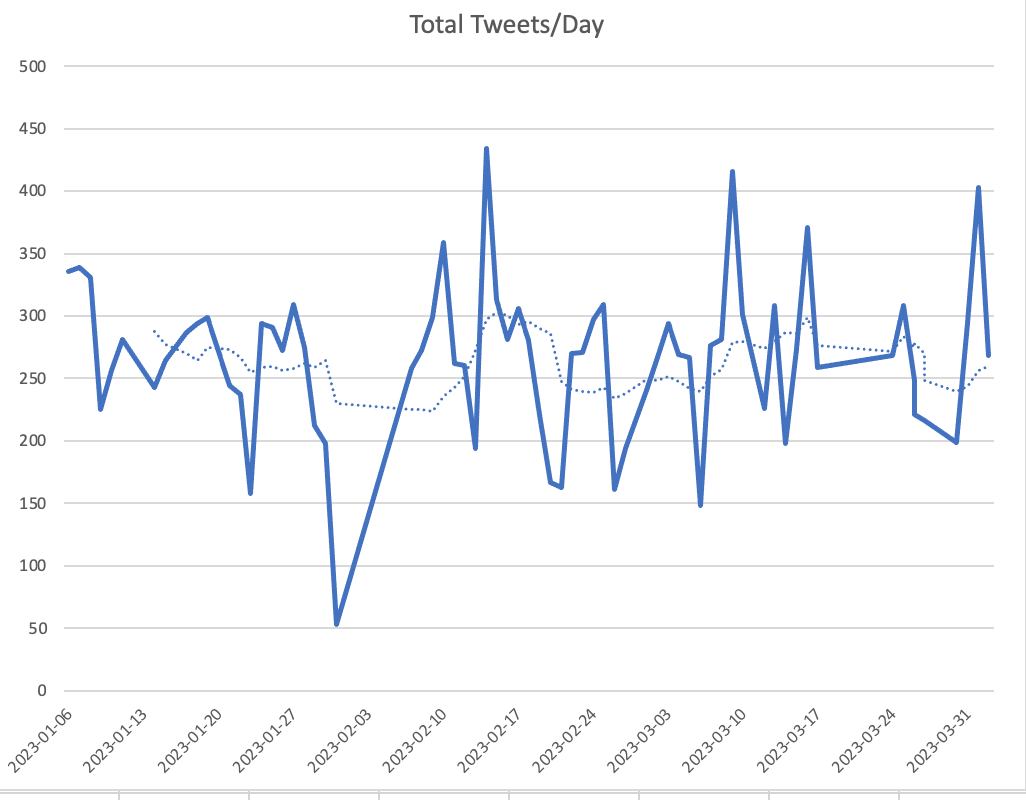

:max_bytes(150000):strip_icc():format(webp)/GettyImages-478046597-5cfcc543ecb846fd9783fed2be56fa06.jpg)
 Smart People I Know